
Real Questions. Big Ideas. Brighter Thinkers.
The Heart of Launchpad
Discovery Lab is our flagship programme — and perhaps the clearest expression of why Launchpad exists.
It is where we step beyond syllabi, marks and traditional subject boundaries and give curious young people the freedom to explore remarkable questions, encounter unfamiliar fields and develop their own ways of thinking.
If one programme captures what Launchpad is all about, it’s Discovery Lab.
We will grapple with questions such as:
- Could a human survive completely alone?
- Why do fish form schools?
- How did humans learn to push back the sea?
- Can mathematics describe the shape of a fern?
- Why do some animals pretend to be something they’re not?
- What happens when scientists pursue an idea with no obvious practical use?
Discovery Lab is where we explore, ask daring questions, and funnel creativity to learn how to problem-solve.
It is a weekly interdisciplinary programme for Grades 10–12, designed to expose learners to ideas, disciplines and ways of thinking they may never encounter in the ordinary school curriculum.

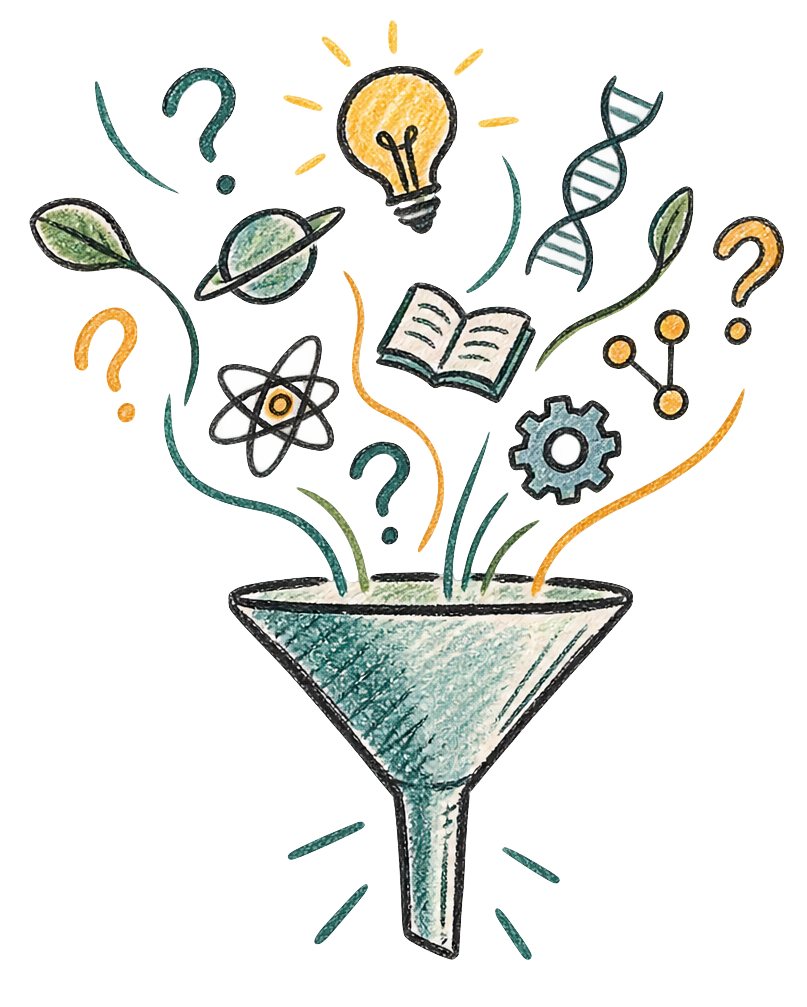
Curiosity needs to be funneled
Young people are naturally curious, but as they progress through school, learning increasingly becomes organised around subjects, syllabi, assessments and examinations.
Those things matter.
But education should also leave room for asking:
Why?
How do we know?
What would happen if…?
Is there another explanation?
How are these ideas connected?
Discovery Lab creates deliberate space for those questions.
Rather than teaching another syllabus, we use fascinating problems, discoveries, controversies and ideas as starting points for exploration.
The objective is not simply to know more.
It is to think more deeply.
Our Vision
We want to help develop young people who are intellectually curious, scientifically literate and comfortable exploring unfamiliar ideas.
Learners should leave school knowing more than the contents of their textbooks.
They should begin to understand how mathematicians, scientists, engineers, doctors, historians, programmers, artists and philosophers approach problems differently.
They should encounter fields they didn’t know existed.
They should discover questions they didn’t know they could ask.
And, importantly, they should begin figuring out:
What fascinates me?


How Discovery Lab Works
Each session begins with a compelling question, phenomenon or problem.
From there, we investigate.
A discussion about why fish swim in schools can lead from evolutionary biology to probability, predator-prey dynamics and mathematical modelling.
The question “Can humans hold back the sea?” can take us through the history and engineering of the Netherlands, fluid dynamics, climate adaptation and the difficult decisions societies make about risk.
Exploring mimicry and deception in nature introduces evolution, ecology, perception, signalling and the extraordinary evolutionary arms races between predators and prey.
And asking “What is a fractal?” can connect mathematics to coastlines, plants, computer graphics, dynamical systems and the structure of the natural world.
The subject changes.
The habit of mind does not:
observe → question → investigate → connect → reason
What Might We Explore?
Discovery Lab deliberately moves across disciplines.
One week we might investigate how jumping spiders see colour and how scientists can design experiments to understand an animal’s perception of the world.
Another might explore the mathematics of probability, from everyday intuition to the Monty Hall problem and Bayesian reasoning.
We might investigate mycelium networks beneath forests, asking what fungi and trees actually exchange — and where popular descriptions of the “wood wide web” go beyond the evidence.
We could trace the development of perspective in art, where geometry, perception, history and artistic technique unexpectedly meet.
Or investigate blue-sky science: why societies spend money studying questions with no obvious practical application, and how apparently useless discoveries have sometimes transformed civilisation decades later.
There is no artificial boundary between “science”, “humanities” and “the real world”.
If a question is worth asking, it belongs in Discovery Lab.


We Don’t Just Want to Give Learners Answers
We want them to become better at evaluating answers.
That means learning to distinguish between:
- evidence and assertion
- correlation and causation
- a plausible explanation and a demonstrated one
- what we know and what we think we know
- a good argument and a persuasive-sounding one
Learners are encouraged to question ideas — including the ideas presented to them.
Because intellectual confidence does not come from always knowing the answer.
It comes from knowing how to approach a question when you don’t.
Why Does This Matter?
The world these learners will enter is changing extraordinarily quickly.
They will have access to more information — and more misinformation — than any previous generation.
Artificial intelligence can already produce explanations, essays, computer code and solutions in seconds.
Simply possessing information is becoming less distinctive.
The ability to ask good questions, evaluate evidence, connect ideas, recognise assumptions and reason independently becomes more important.
These are not only academic skills.
They are tools for navigating adulthood.

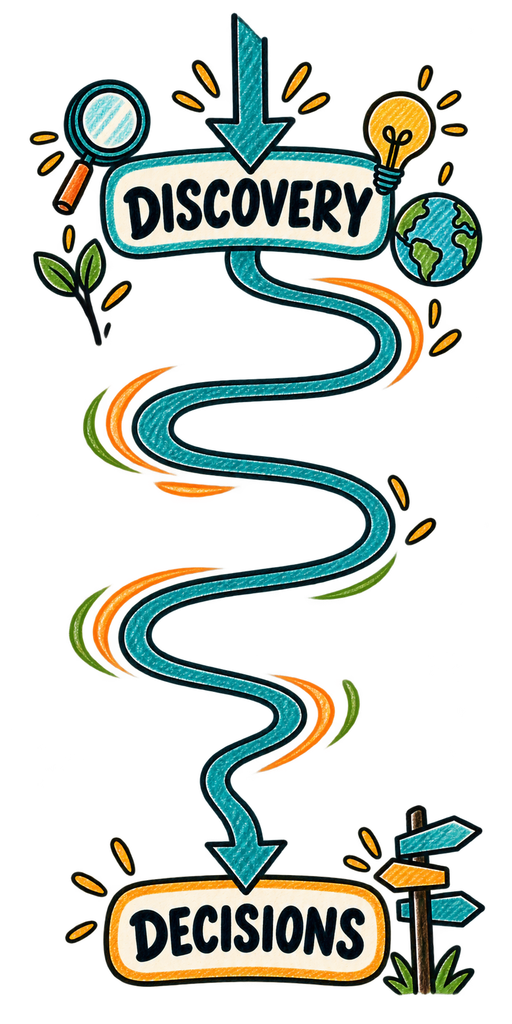
Discovery Before Decisions
By Grades 10–12, learners are already being asked to make surprisingly consequential choices.
What subjects should I take seriously?
What should I study?
What career should I pursue?
University or something else?
Science? Engineering? Medicine? Computing? Design? Economics?
It is difficult to choose between worlds you have never encountered.
Discovery Lab therefore also serves another purpose:
Exposure.
We want learners to encounter fields, problems and ways of working before they have to decide whether those worlds might be for them.
A learner may arrive convinced that they “don’t like biology” and discover they are fascinated by genetics.
Someone who thinks mathematics is only about calculations may encounter mathematical modelling, probability or fractals.
Someone interested in art may discover optics, geometry, psychology or computational design.
Sometimes finding a direction begins with encountering the right question.
Who Is Discovery Lab For?
Discovery Lab is especially suited to the learner who:
- constantly asks “why?”
- enjoys documentaries, YouTube explainers, podcasts or unusual facts
- has interests that don’t fit neatly into one school subject
- is academically capable but bored by purely syllabus-driven learning
- wants to understand what different scientific and intellectual careers actually involve
- enjoys discussing ideas and challenging assumptions
- hasn’t yet discovered what really excites them
They do not need to arrive knowing a lot.
They need to arrive willing to wonder.

What We Hope to Develop
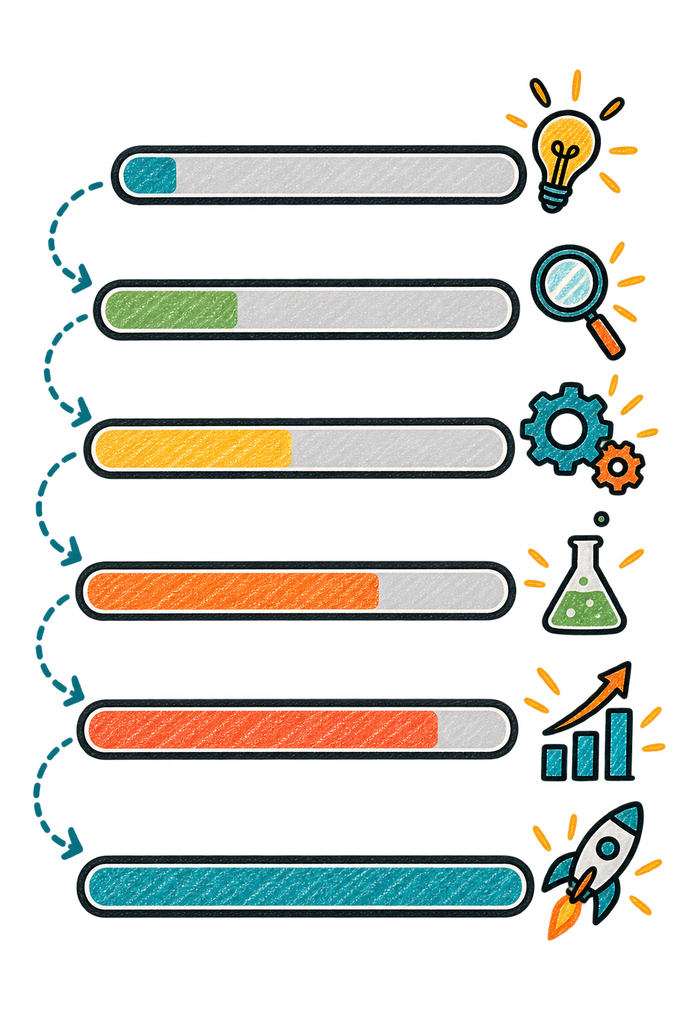
Over time, Discovery Lab aims to strengthen:
Curiosity
The instinct to look beyond the obvious answer.
Critical thinking
The ability to evaluate claims, assumptions and evidence.
Scientific reasoning
Understanding how we can test ideas and establish what we know.
Systems thinking
Recognising relationships between different parts of complicated problems.
Interdisciplinary thinking
Connecting ideas across mathematics, science, technology, society, history and the arts.
Intellectual independence
Becoming comfortable forming — and revising — your own conclusions.
A sense of direction
Discovering subjects, questions and possible futures worth pursuing.
The Bigger Idea
Discovery Lab is not about producing walking encyclopaedias.
And it isn’t necessarily about getting ahead with next year’s syllabus.
We are trying to cultivate something harder to measure: an active intellectual life.
The kind of learner who notices something strange and wants to understand it.
Who encounters a claim and asks what evidence supports it.
Who can say “I don’t know” without being intimidated by the question.
Who discovers a subject they’ve never encountered before and thinks:
I want to know more about that.
That is the learner Discovery Lab is designed for.

If This Sounds Like Your Child, Send Them Our Way.
If your child comes home with questions you don’t always know how to answer, disappears down rabbit holes about strange topics, takes things apart to see how they work, argues about whether something actually makes sense, or simply hasn’t yet found the subject that truly captures their imagination —
we would very much like to meet them.